top of page
The Rise of the Church
How an Obscure Sect Conquered an Empire: 5 Counter-Intuitive Truths About the Rise of Christianity
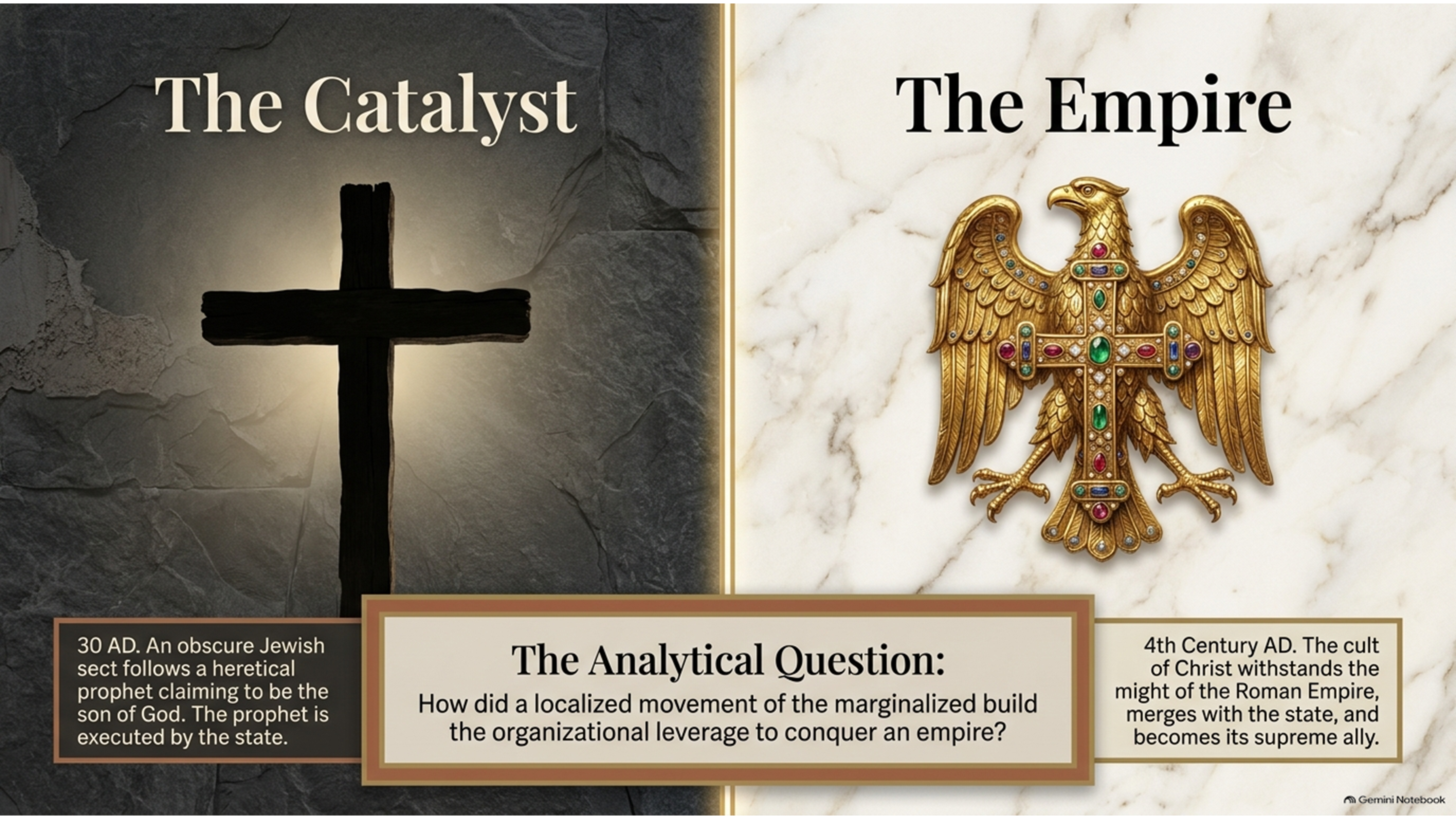
How did a tiny, heretical Jewish cult surviving in the margins of the Roman Empire transform into the official state religion and ally of that same imperial superpower? At its dawn, the movement followed a heretical prophet preaching an imminent day of judgment, urging believers to abandon sin before the arrival of the kingdom of God.
Yet, against all historical odds, this obscure group withstood imperial persecution, expanded rapidly across the Mediterranean, and eventually displaced the ancient pagan order. The story of its rise is not merely one of spiritual zeal, but of counter-intuitive practical adaptations, socio-economic levers, and political pivots that turned a radical underground movement into an empire-defining institution.
Takeaway 1: St. Paul Dropped Religious Rules Because He Thought the End of the World Was Minutes Away
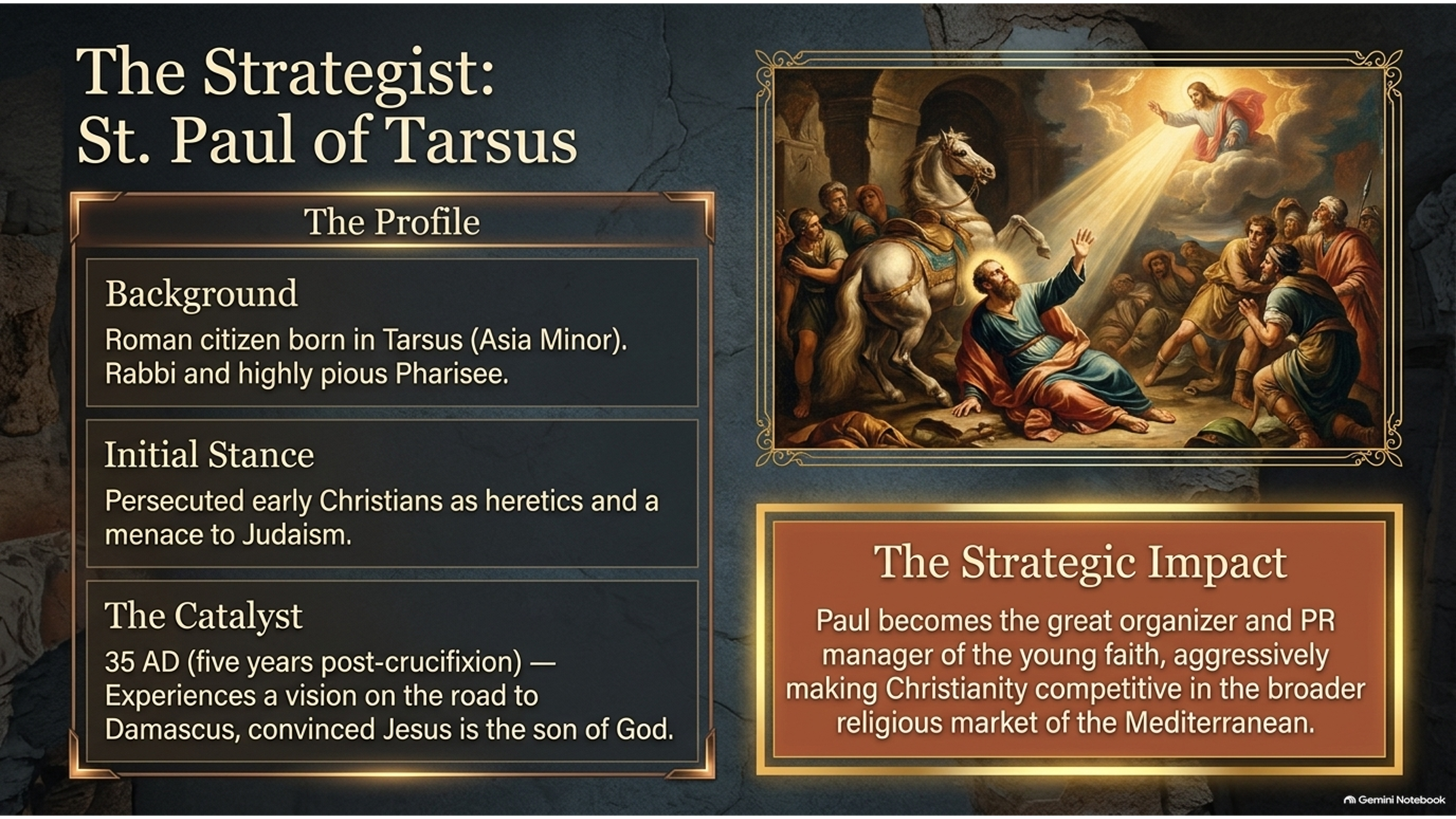
The initial transition of Christianity from a localized Jewish movement into an expansive international faith was orchestrated largely by St. Paul. Born in Tarsus as a Roman citizen, Pharisee, and devout rabbi, Paul originally persecuted Christians as dangerous heretics. However, following a profound vision on the road to Damascus around 35 AD, he became the primary organizer and public relations strategist for the young faith, radically broadening its reach to non-Jews.
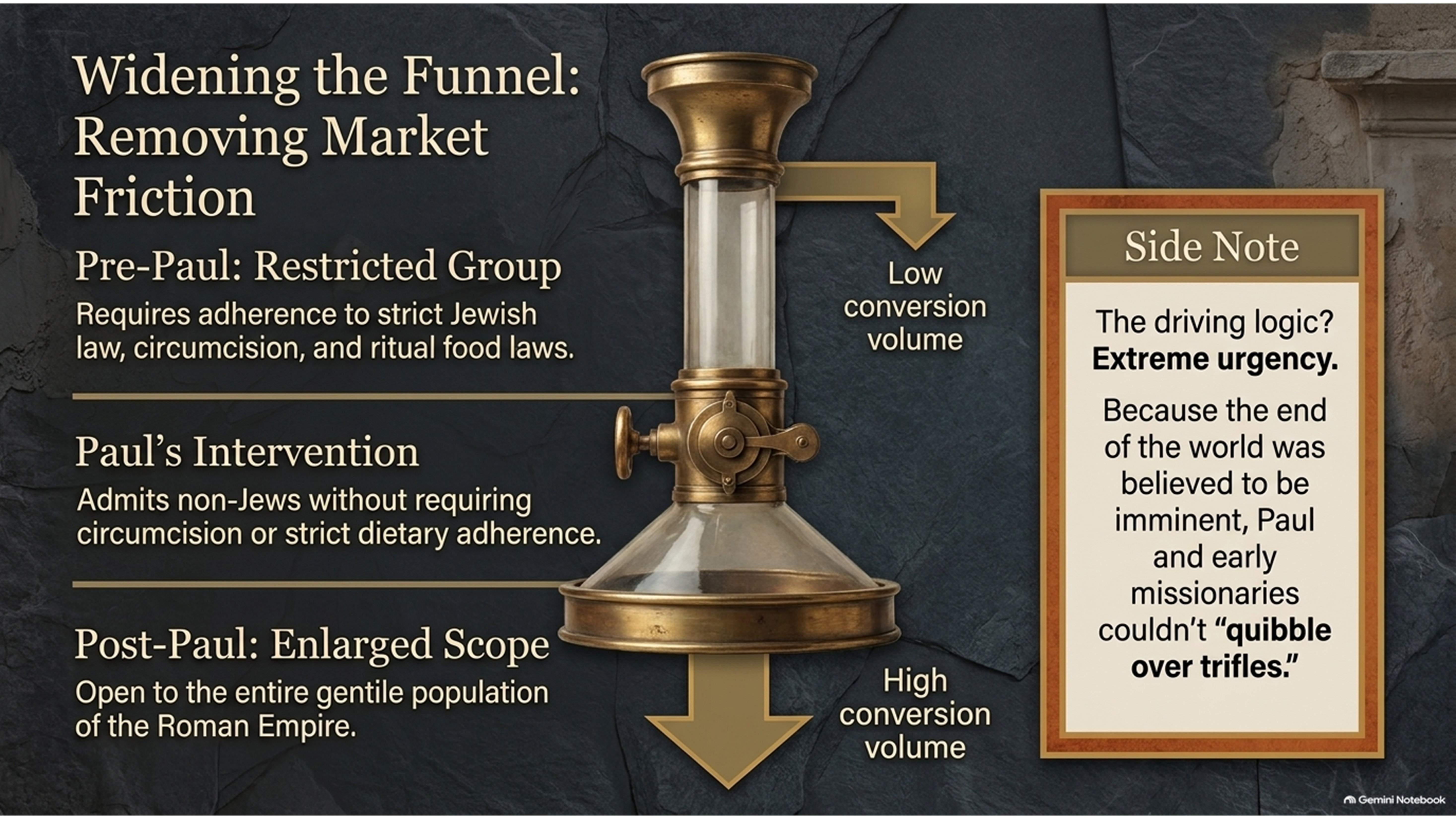
To recruit converts outside traditional Jewish circles, Paul took the pragmatic step of eliminating steep cultural barriers to entry. He waived the requirement of circumcision and dropped strict kosher dietary laws. This was far more than a liberal policy shift: Paul made these concessions because he believed he was in an urgent race against time. Operating under the conviction that the end of the world was imminent, he refused to quibble over procedural trifles when souls needed saving before the final judgment.
The Roman Empire had inadvertently constructed the ideal infrastructure for Paul’s apocalyptic mission. The vast network of Roman roads and the overarching stability of the Pax Romana physically linked the Mediterranean, allowing traveling preachers to move with unprecedented safety. Simultaneously, the spread of Koine—the common Greek dialect—created a bilingual Mediterranean world where missionaries could make themselves understood in virtually every major port city. Preachers were further aided by the Septuagint, a Greek translation of the Hebrew scriptures completed by 70 scholars in Alexandria two centuries earlier. Synagogues throughout Hellenistic cities already studied this text, providing early Christian evangelists with a ready-made library and audience.
This expansion accelerated dramatically after the Roman general Titus crushed the Jewish uprising and sacked the Temple in Jerusalem in 70 AD. The destruction of Jerusalem shattered Orthodox Jewish administrative authority, making it far easier for Christians to break free from their parent faith. With the physical Jerusalem reduced to rubble, early Christians projected an ideal, heavenly Jerusalem into the skies, severing their earthly political ties and transforming a regional reform movement into a universal, competitive religion.
Takeaway 2: Christianity Was the "Budget-Friendly" Mystery Cult of the Ancient World
During its first three centuries, Christianity competed directly with popular "mystery religions" across the Roman world, most notably the cults of Mithras and Isis. While these rival faiths offered personal salvation and secret revelations, they imposed steep economic costs on their adherents. Christianity grew exponentially because it functioned as an exceptionally accessible alternative:
The Cult of Mithras: Required the costly sacrifice of an entire bull for initiation, restricting full participation to wealthy devotees and military officers who could afford expensive animal offerings.
The Cult of Isis: Demanded a continuous series of expensive gifts, formal sacrifices, and costly rituals to ascend its spiritual hierarchy.
Christianity: Imposed zero initial fees or financial entry requirements, welcoming non-citizens, women, and the poor to gatherings that often felt like emotional Sunday school picnics.
To operate under the radar of imperial authorities, early Christians cleverly took advantage of Roman legal protections surrounding "burial societies." By organizing legally as guardians of underground burial tunnels, or catacombs, the church built a disciplined, tightly knit network that could meet, discuss scripture, and maintain organizational continuity even during periods of state persecution.
While joining the church cost nothing, voluntary almsgiving was strongly encouraged among those who had means. Early Christians viewed almsgiving not merely as selfless charity, but as a judicious transfer of capital from this world to the next—a spiritual form of fire insurance. By the third century, these accumulated funds were placed into the hands of local bishops, creating a financial powerhouse dedicated to social welfare and public relief.
Takeaway 3: To the Roman Elite, Christians Were Dangerous, Anti-State Radicals
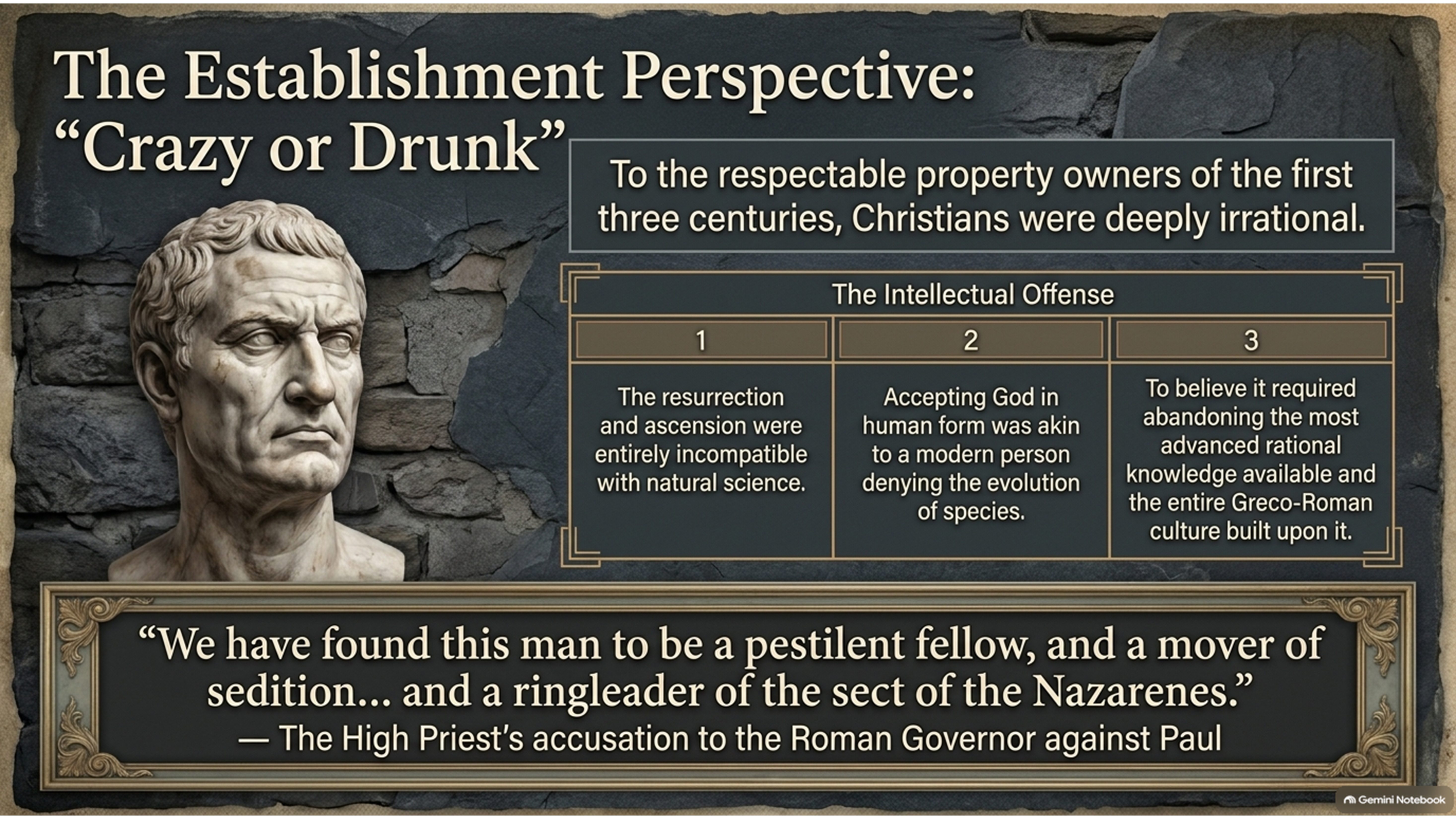
To respectable Roman property owners, intellectuals, and magistrates, early Christians did not look like pious citizens; they looked crazy, drunk, or treasonous. To a late pagan intellectual, accepting that God had taken human form in Jesus was as absurd as a modern person denying the evolution of species—it required abandoning the established Greco-Roman rational tradition.
Worse still, Christian doctrine threatened the social hierarchy and imperial values that held Roman society together. Preaching that all human beings were brothers, Christians asserted that a beggar was as good as a solid citizen and that a slave was equal in essence to his master. They openly rejected material wealth, social status, family loyalty, and service to the state, echoing the radical command to leave family behind to save one's soul.
This unworldliness was championed by third-century Christian scholars like Origen, who argued that Christians belonged solely to the "divine nation" of the church and should refuse to participate in secular government. Most alarming to imperial authorities was the Christian insistence that Caesar's authority had strict limits. By placing allegiance to God above obedience to the emperor, Christians challenged the stoic tradition of civic duty and threatened the religious unity required by the state.
The subversiveness of these early radicals is captured in the formal accusation brought by a Jewish high priest to the Roman governor regarding St. Paul:
"We have found this man to be a pestilent fellow, and a mover of sedition among all the Jews throughout the world, and a ringleader of the sect of the Nazarenes."
Takeaway 4: Bishops Won Civic Power by Outperforming Corrupt Roman Officials
As the administrative infrastructure of the Roman Empire began to disintegrate in the third and fourth centuries, urban centers fell into deep crisis. Cities grew crowded with the starving poor, while citizens were displaced by barbarian incursions, oppressive tax collectors, and predatory landowners.
In this power vacuum, traditional Roman leadership failed to maintain order. Imperial provincial governors were typically "blue-blooded ninnies" appointed for short terms of one or two years. Acting as mere figureheads over ill-paid and thoroughly corrupt administrative staffs, these Roman officials offered little actual governance or relief to struggling populations.
By contrast, Christian bishops emerged as permanent, dedicated fixtures within their towns. Responsible only to God, a bishop managed the vast charitable reserves accumulated through generations of almsgiving, using these resources to systematically feed the hungry and shelter the destitute.
By the fourth century, bishops expanded their civic authority even further by offering free, fast, and uncorrupt settlements of lawsuits through arbitration. Because the local bishop was frequently the only honest, powerful leader in town, his courtroom was flooded by citizens seeking fair judgment. Pagans and heretics sought out the local bishop to resolve their commercial and civil disputes just as eagerly as Christians did, effectively shifting the administrative heart of the Roman city from imperial basilicas to the Christian altar.
Takeaway 5: Once in Power, the Oppressed Fast Became the Intolerant Oppressors
The trajectory of the church altered permanently during the imperial civil wars of the early fourth century. Before the decisive Battle of the Milvian Bridge in 312 AD, Emperor Constantine sought divine aid against his rival Maxentius, whose troops relied on the favor of Sol Invictus (the Invincible Sun). After experiencing a vision promising victory under the sign of the cross, Constantine ordered his soldiers to paint the Christian emblem onto their shields. His victory over Maxentius led to the Edict of Milan, granting full religious tolerance to Christians and establishing an enduring alliance between the church and the state.
However, within a few decades, state-sanctioned tolerance flipped into state-enforced intolerance toward all competing beliefs. Public paganism was officially suppressed around 400 AD. Christian mobs shuttered pagan academies, smashed ancient statues, and demolished sacred structures, such as the Temple of Artemis in Jordan. Proud stone inscriptions celebrating the ancient alliance between cities and their traditional gods were carted off to pave public highways, while organized pogroms targeted Jewish communities across Hellenistic cities.
Pagan intellectuals and philosophers faced severe violence, exemplified by the lynching of Hypatia, a renowned female mathematician and philosopher in Alexandria. The historian Edward Gibbon recorded her horrific death at the hands of a Christian mob in 415 AD:
"Hypatia was torn from her chariot, stripped naked, dragged to the church, and inhumanely butchered by a troop of savage, merciless fanatics... Her flesh was scraped from the bones with sharp oyster shells, and her quivering limbs were delivered to the flames."
Once external opponents were silenced, Christians turned their ideological passion upon one another. Violent doctrinal disputes erupted over the Trinity and the precise nature of Christ—whether he was a man who became God, a God who became man, or a figure possessing one or two natures. Imperial cities aligned with competing theological stances, with Constantinople championing two distinct natures in Christ while Alexandria insisted on one. These abstract debates over orthodoxy degenerated into centuries of bloodshed and civil strife, transforming theological disagreements into violent regional conflicts.
Conclusion: The Transformation of the "Alternative Society"
In its infancy, early Christianity functioned as an alternative society—a peaceful refuge from a harsh Greco-Roman world that believers viewed as corrupt and demonic. Its original followers saw themselves as "athletes in Christ," engaged in an intense internal struggle against evil, darkness, and their own lower natures.
However, as the institutional church achieved imperial favor, this alternative society became society itself. The once-oppressed cult inherited the full coercive apparatus of the Roman state, shifting its energy from surviving external persecution to aggressively enforcing internal conformity. When a radical, counter-cultural movement achieves absolute institutional dominance, does it inevitably adopt the very oppressive tools of the power structure it originally sought to replace?
Project type
The Rise of the Church: Eugen Weber - The Western Tradition
Date
30 September 2026
Location
Principality of Sealand

01
The Rise of the Church

01
From_Catacomb_to_Basilica

02
2From_Catacomb_to_Basilica

03
3From_Catacomb_to_Basilica

04
4From_Catacomb_to_Basilica
bottom of page