top of page
UCLA Historian Eugen Weber on St PAul of Tarsus
The Christians inherited a lot of things from the Jews, including the Semitic sense of world worthlessness and the conflict between body and spirit. And they took over, too, the typically Jewish vision of a blinding, all-powerful God above and the abject condition of man below with his overwhelming sense of sin and a passion for salvation. But this salvation could not come from anything man could do, as the rationalist Greeks might have argued, but only from God, or, as St. Paul later put it, from faith in God, which in Christian terms is simply faith in the reality and value of Christ's sacrifice.
However, there is one thing to remember about all this. At the beginning, in order to be a Christian, you had to be a Jew. There was no thought of separateness in Christian communities, which were merely reformed religious groups within a Jewish community.
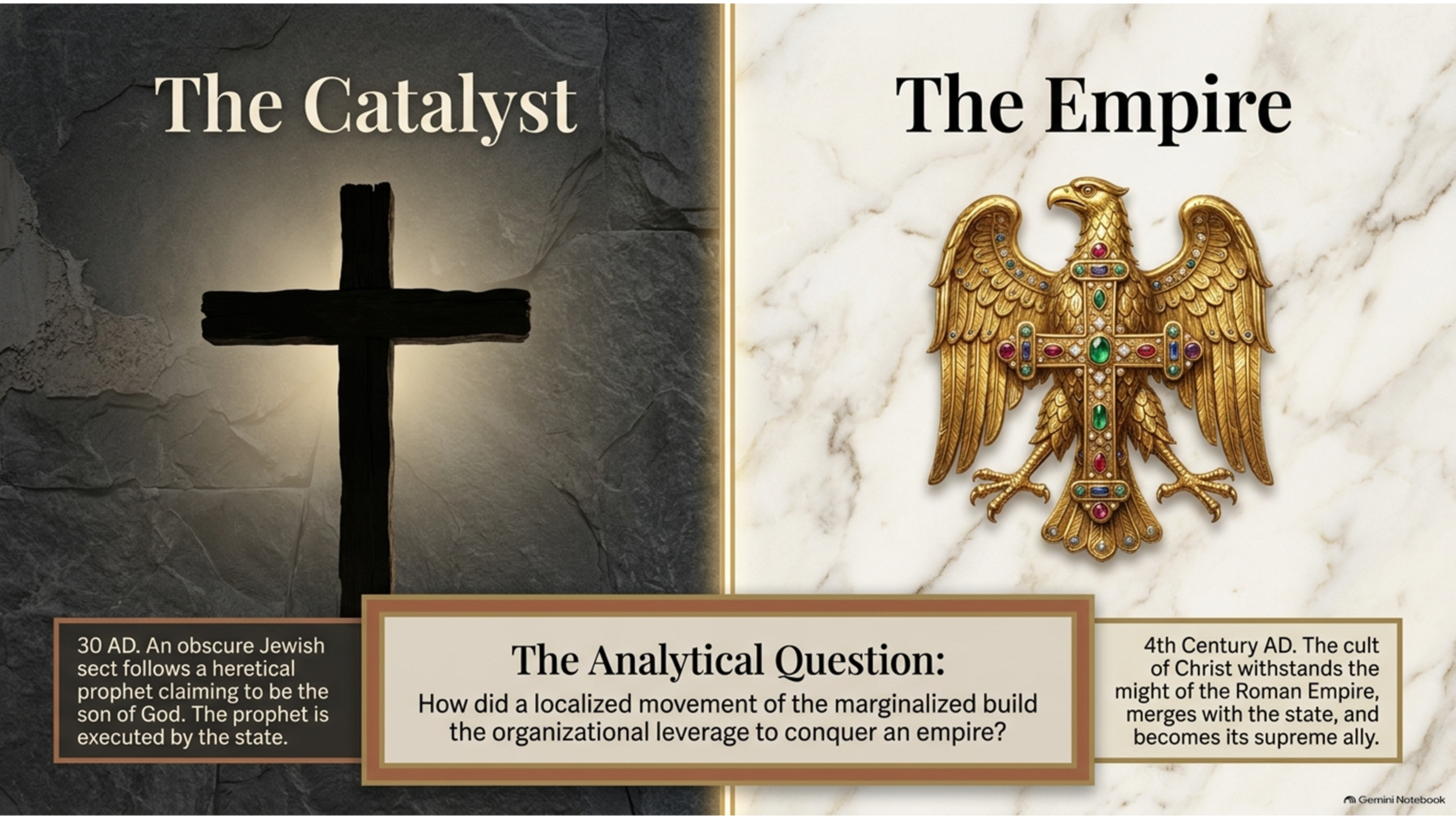
We shall see how this changed and why in our next programme. Obscure Jewish sect follows the teachings of a heretical prophet who claims he is the son of God. How did the cult of Christ withstand the might of the Roman Empire and then become its ally? The rise of the Church, this time on the Western Tradition.
And now, UCLA professor Eugen Weber's continuing journey through the history of Western civilisation. Last time, we ended at the dawn of Christianity when Christ and his disciples were preaching to their fellow Jews a sort of Reform Judaism, where the long tradition of the Hebrew prophets promised the coming of a Messiah who would establish the kingdom of God on Earth. Jesus seems to have preached that there would be no kingdom, but instead a day of judgement coming very soon when the wicked would be punished and the righteous rewarded.
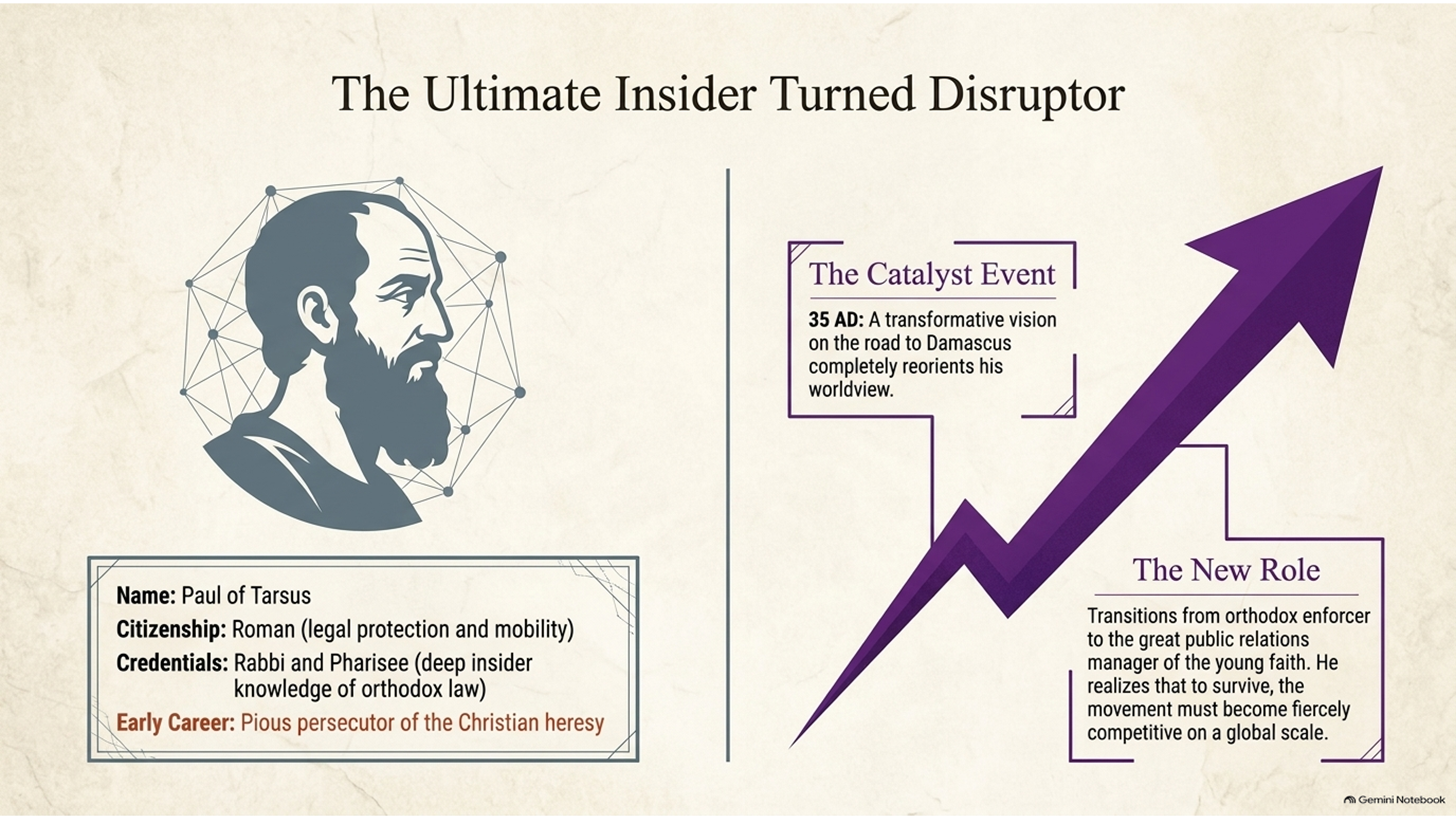
And so the message was, abandon all sin while you still have time. This was definitely a departure from orthodoxy, but even so, there was no thought of separateness in Christian communities until that is St. Paul came along. Paul was a Roman citizen born in the city of Tarsus in Asia Minor.
He was a rabbi and a Pharisee, in other words, a very pious Jew. And as a pious Jew, he persecuted Christians whom he regarded as heretics and a menace to Judaism. But around 35 AD, five years after the crucifixion of Christ, Paul had a vision on the road to Damascus and he became convinced that Jesus was the son of God.
Here is a 15th century version of Paul's conversion. Paul turned out to be the great organiser, the great public relations manager of the young faith. And in effect, he made Christianity competitive with other religions.
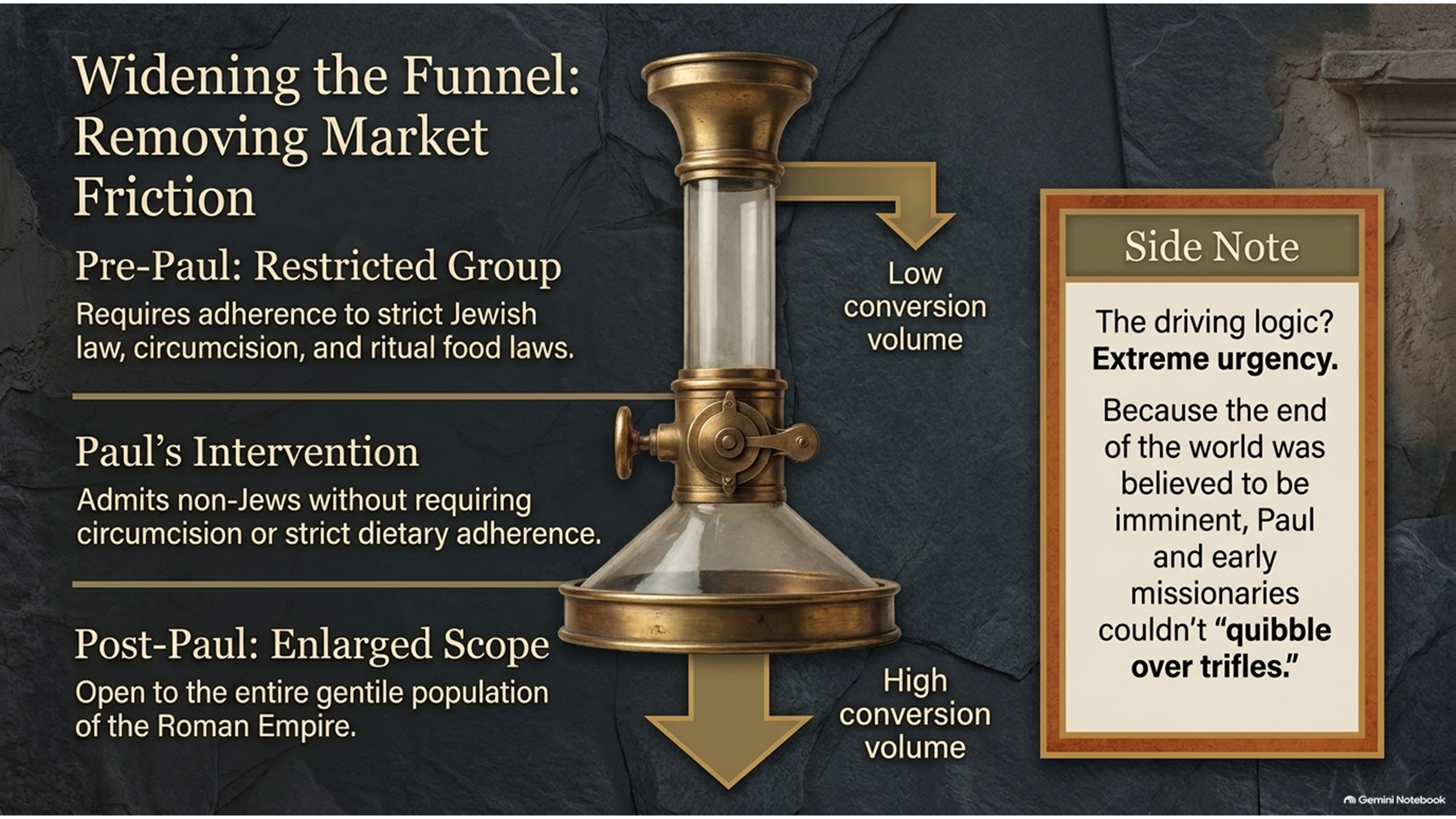
He enlarged its scope by recruiting outside the restricted group of people who obey Jewish law. He admitted non-Jews without asking them to be circumcised first and without insisting they respect the ritual laws, especially the laws concerning food. He probably did it because he was in a hurry.
The end of the world was coming and you couldn't quibble over trifles. But it's worth remembering that Paul and his like were able to spread Christianity because of Roman roads and Roman peace, as well as his skill and the religion's appeal. It was Rome that linked the Mediterranean world together.
Equally important was the Koine, the Greek's common dialect, which spread from east to west, making all the Mediterranean a bilingual world where travelling men could make themselves understood everywhere. St. Paul wrote to the Romans in Greek and until early in the third century AD, the language of Christian liturgy in the Church of Rome was Greek. It was also into Greek that Hebrew scriptures had been translated two centuries before Christ.
That extremely important translation was finished in Hellenistic Alexandria with its great Jewish community. It was called the Septuagint, from the Latin for 70, because there were supposed to have been 70 translators. And so it was ready for early Christian missionaries when they began to carry their message through the world.
In the synagogues, which you could find in Hellenistic cities like this one at Dura Eropos, the translations of the Hebrew scriptures were read and studied. And I don't think the early Christian church would have gone very far, or Paul either, without the Septuagint and the synagogue and without writing the New Testament in the Greek Koine from the very beginning. So here you have a crucial interconnection of factors.
First, the conquests of the Roman Empire which unified the Mediterranean world. Second, the Hellenistic creation of a common speech for this world. Both were preconditions for the advance of Christianity.
However, as time went on, the Jews became increasingly hostile to Christians, and the Christians also became more and more hostile to the Jews. To the Jews, the Christians were heretics. To the Christians, the Jews were wilfully blind to what was so evident and so evidently holy.
And so Christianity separated from Judaism. It left the fairly straightforward path of Jewish religious thought and moving westward along both shores of the Mediterranean, it started to appeal to a new public and to develop a theology of its own. This advance of Christianity was spurred in the second half of the first century by a great Jewish rising against Rome and a wave of anti-Semitism that swept over the east about the same time.
But then the Roman general Titus put down the uprising and sacked the Jewish temple in Jerusalem in 70 AD. This is the Roman procession with the spoils of Jerusalem. At this point, the Christians were still pretty much a Jewish sect and they were emotionally affected by the humiliating defeat.
But then two things happened. On the one hand, a lot of Christians were left with an abiding hatred of secular power. On the other hand, as you can tell from this coin with the inscription Judea taken captive, established Jewish communities and the power of Orthodox Jewish religion temporarily collapsed so the Christians found it easier to break free.
The earthly Jerusalem had been destroyed so that now the ideal version could be better projected into heaven without having to worry about real nations and real governments. The result of all this can be found in the suggestion made by Origen, a Christian teacher who lived in Alexandria in the third century. Origen wrote that Christians should not take part in the government of the state, but that their only concern should be the divine nation, that is, the church.
Some churchmen went even further, denying the world and their own bodies, which in the dichotomy between spirit and flesh came out a poor second. They gave away their property, they fasted, they flagellated themselves, and Origen advocated complete chastity, probably had himself castrated. If the church had heeded Origen, its story would have ended there.
But fortunately, St. Paul suggested it was better to marry than to burn. Still, the unworldly anti-secular ideas of Origen remained influential, and as the Roman Empire disintegrated, churchmen looked on with some detachment. They exercised their talents in bitter theological controversies and in the spread of monastic communities like this one in Greece, cut off from the wicked world where Christians could concentrate on personal salvation and spend their lives in contemplation and penitence.
It can be argued, and it was argued even at the time, that this attitude was a sort of sour grapes, a retreat from the world when the world became too hard to bear, denying earthly values in order to secure oneself against their loss. It can also be argued, however, that when you deny certain values, you are, at least by implication, you are affirming alternative
Project type
UCLA Historian Eugen Weber
Date
1 October 2026
Location
Pretoria, DPSA, 16h20

01
UCLA Historian Eugen Weber on St PAul of Tarsus

01
The_Paul_Pivot

02
From_Catacomb_to_Basilica

03
3From_Catacomb_to_Basilica
bottom of page